
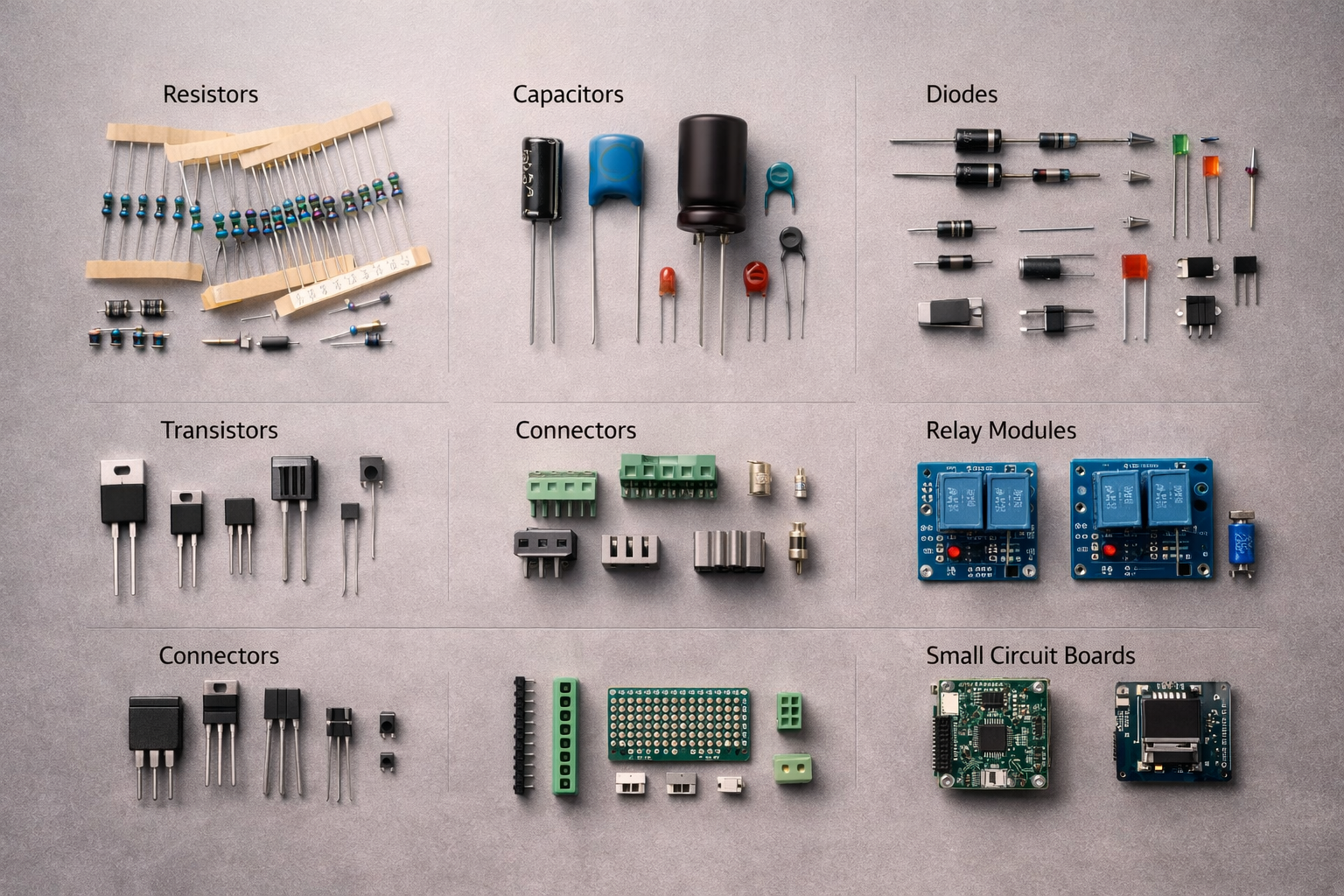
Whether you are a DIY enthusiast, circuit builder, technician or simply an electronics hobbyist — there are a number of basic components that are good to always have on hand. Having these parts saves time, allows quick fault diagnosis and prevents work from stopping at the most inconvenient moment. For a beginner — this is the foundation of practice. For an experienced specialist — an essential working stock.
Why Having a Basic Stock is Important
Even a simple fault often requires replacing a standard part: a resistor, capacitor, diode, transistor, connector or voltage regulator. If the needed component is not on hand, the repair must be postponed or a replacement urgently sourced. A small stock of basic items helps: perform diagnosis faster; avoid losing time waiting; have replacement options; test and assemble circuits; increase workshop efficiency.
Which Components are Needed First
1. Resistors
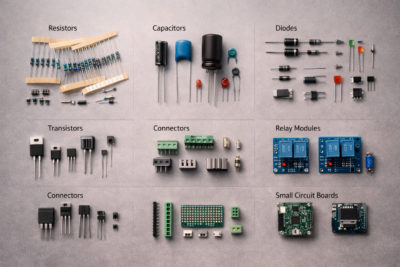
One of the most common parts in electronics. Resistors are used in almost every circuit: from simple boards to control units. It is better to have a set of popular values.
2. Capacitors
Capacitors are also among the basic components. They participate in filtering, stabilisation, smoothing and energy storage. It is useful to have: electrolytic capacitors; ceramic capacitors; common values for repairing boards and power supplies.
3. Diodes
Diodes are used for rectification, protection, limiting and switching. Worth keeping in stock: rectifier diodes; fast diodes; Schottky diodes; Zener diodes; LEDs for indication.
4. Transistors
Transistors are used in amplifiers, switches, voltage regulators, power supplies and control circuits. Even a minimal set of popular transistors significantly simplifies repair and assembly work.
5. General-Purpose Integrated Circuits
Not rare specialised chips, but basic items frequently encountered in projects and repairs: operational amplifiers, timers, logic gates, drivers and voltage regulators.
6. Connectors and Terminal Blocks
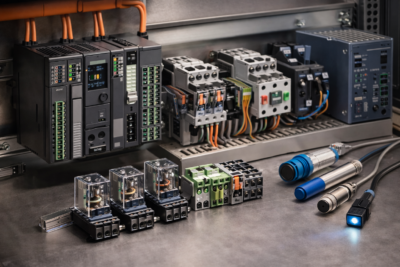
Practical electronics almost always requires connecting wires, modules, sensors and power. That is why it is useful to have: pin connectors; terminal blocks; connectors; power connectors.
7. Fuses and Protection Elements
During repairs and testing, having fuses, varistors, thermistors and protection diodes on hand greatly helps with quick restoration or protection of a device.
8. Buttons, Switches, Relays
Not just control elements, but also frequently replaced parts. Particularly useful when repairing household, industrial and domestic electronics.
What Consumables Should Be on Hand
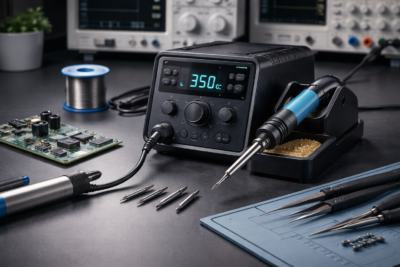
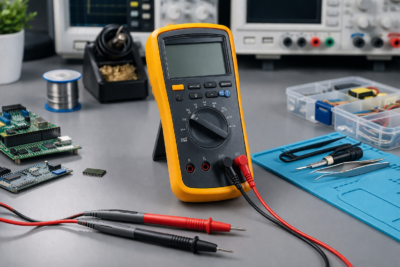
In addition to the components themselves, it is useful to have: solder; flux; heat-shrink tubing; jumpers; hookup wire; prototyping boards; tweezers; a probe set.
How to Store Electronic Components
So that parts do not get lost or mixed up, it is important to organise storage from the start: compartment containers; labelled boxes; anti-static bags; organisers by category and value.
Conclusion
A basic stock of electronic components is the foundation of efficient work in both a hobby and a professional workshop. When the most essential parts are on hand, problems are solved faster and work becomes considerably more comfortable.